
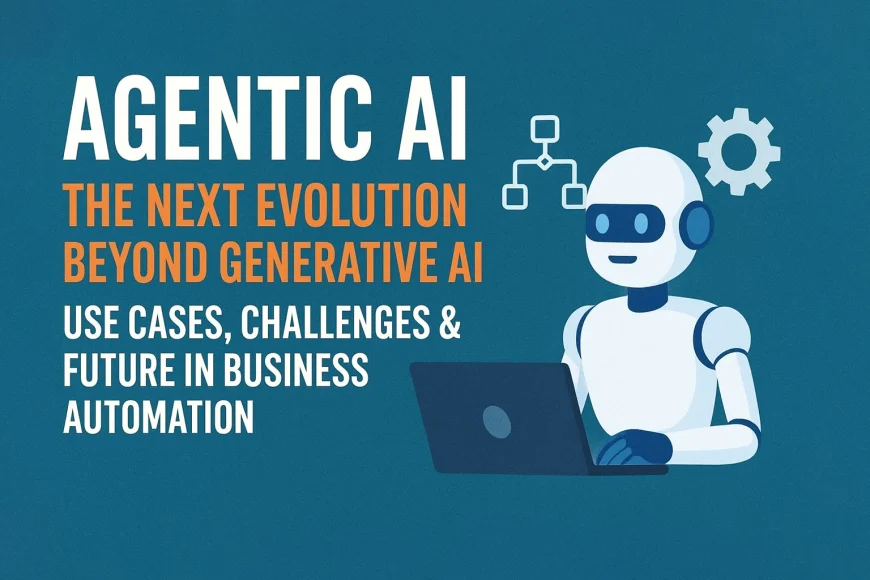
Agentic AI: The Next Evolution Beyond Generative AI - Use Cases, Challenges & Future in Business Automation
Agentic AI is redefining how businesses operate by going beyond content creation to autonomously executing complex tasks and decisions. This blog explains what Agentic AI is, how it differs from Generative AI, explores real-world business use cases of autonomous agents, and highlights the challenges and risks of deploying task-automating AI systems.
Artificial Intelligence has rapidly evolved from generating content to taking action. While Generative AI models like ChatGPT and Midjourney focus on creating text, images, or code, the next wave—Agentic AI—is designed to think, plan, and act autonomously. Agentic AI represents a shift from static output generation to dynamic, goal-driven execution, where AI systems perform tasks, make decisions, and even collaborate with other digital systems without human intervention.
What is Agentic AI?
Agentic AI refers to autonomous AI systems (or “agents”) capable of planning, reasoning, and acting within defined goals. These agents use a combination of Generative AI, machine learning, and reinforcement learning to perform multi-step tasks-like scheduling meetings, managing data pipelines, or automating customer workflows.
Unlike traditional chatbots or generative tools that wait for prompts, agentic systems can:
-
Understand context and objectives.
-
Execute tasks across multiple tools or APIs.
-
Learn from results to improve future actions.
In simple terms, Generative AI creates, while Agentic AI completes.
How Agentic AI Differs from Generative AI
| Aspect | Generative AI | Agentic AI |
|---|---|---|
| Primary Function | Creates content (text, image, audio, code) | Executes tasks and makes decisions |
| User Interaction | Requires manual prompts | Operates autonomously based on goals |
| Example Tools | ChatGPT, DALL·E, Gemini, Claude | AutoGPT, LangChain Agents, Microsoft Copilot, OpenAI o1 |
| Core Capability | Pattern generation | Planning, reasoning, execution |
| Outcome | Creative output | Action-oriented result |
Generative AI acts as the “brainstorming assistant,” while Agentic AI is the “digital employee” that can act on what’s been brainstormed.
Use Cases of Autonomous Agents in Business Workflows
-
Customer Support Automation
AI agents can handle end-to-end support tickets - understanding issues, retrieving data from CRM systems, and resolving queries automatically without requiring human escalation. -
Sales and Marketing Automation
Agents can autonomously manage email campaigns, analyse performance metrics, and optimise ad spends using real-time analytics. -
Financial Operations
Autonomous agents can reconcile invoices, manage expense reports, detect fraud, and perform compliance checks. -
Data Research and Reporting
Instead of manually gathering data, agents can crawl sources, generate insights, and compile business intelligence dashboards. -
Recruitment & HR Workflows
From shortlisting candidates to scheduling interviews and sending offer letters - AI agents streamline repetitive HR processes. -
Software Development & Testing
Developer agents can automatically generate, test, and debug code using integrations with repositories like GitHub or Jira.
Challenges & Risks of Task-Automating Agents
-
Data Privacy & Security Risks
Since agents often access sensitive systems, improper configuration or breaches can lead to data exposure. -
Unintended Actions or “AI Drift”
Without human oversight, agents may misinterpret instructions or take incorrect actions, leading to operational risks. -
Lack of Transparency & Explainability
As agents make independent decisions, understanding why they made certain choices can be difficult. -
Integration Complexity
Connecting multiple APIs and software tools securely and reliably requires careful planning and monitoring. -
Regulatory and Ethical Concerns
Autonomous decision-making can blur accountability lines-especially in finance, healthcare, or legal sectors.
Conclusion:
Agentic AI represents the next major leap in artificial intelligence—one that moves beyond creativity to true autonomy. While Generative AI revolutionised creation, Agentic AI will revolutionise execution. Businesses adopting these intelligent agents can unlock significant productivity and innovation gains, provided they strike a balance between efficiency and robust governance, ethical frameworks, and human oversight.
What's Your Reaction?
 Like
0
Like
0
 Dislike
0
Dislike
0
 Love
0
Love
0
 Funny
0
Funny
0
 Wow
0
Wow
0
 Sad
0
Sad
0
 Angry
0
Angry
0

RevealingLies is a news and current affairs website. We publish opinion articles, analysis of issues, news reports (curated from various sources as well as original reporting), and fact-check articles.