
The Saffron Surge: How West Bengal's Political Landscape Shifted in 2026
On May 4th, 2026, Kolkata woke up to a political reality few had confidently predicted just months earlier. The chants of “Paribartan 2.0” echoed across the state as Bharatiya Janata Party (BJP) stormed to power with a commanding mandate, fundamentally altering the political identity of West Bengal.
On May 4th, 2026, Kolkata woke up to a political reality few had confidently predicted just months earlier. The chants of “Paribartan 2.0” echoed across the state as Bharatiya Janata Party (BJP) stormed to power with a commanding mandate, fundamentally altering the political identity of West Bengal. This wasn’t just an electoral victory. It was a structural shift in voter sentiment, governance expectations, and the state’s relationship with national politics.
For over a decade, Mamata Banerjee and her party, All India Trinamool Congress (TMC), had dominated Bengal’s political narrative. But the 2026 verdict marked the end of that era.
The Verdict: A Decisive Mandate
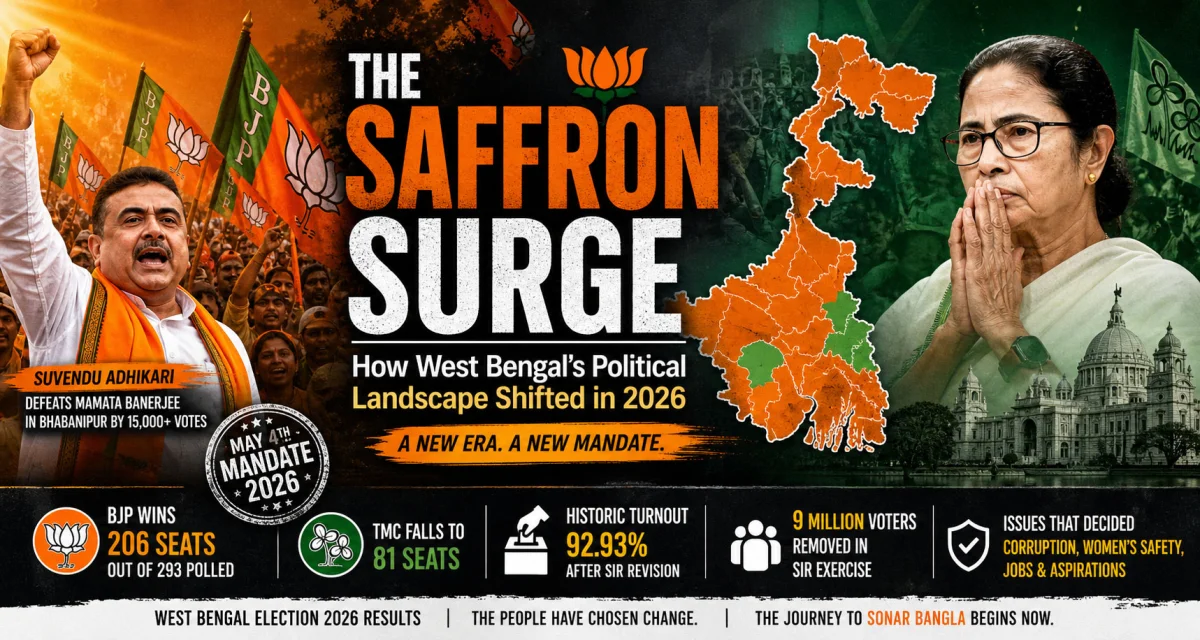
The numbers tell a clear story. Out of 294 seats (293 polled), the BJP secured a massive 206 seats, while the TMC was reduced to 81 seats. Other parties, including Congress and Left allies, managed only marginal gains.
| Feature | Details |
|---|---|
| Total Seats | 294 (293 polled) |
| Winning Party | BJP (206 seats) |
| Opposition Party | TMC (81 seats) |
| Others | ~6 seats |
| Key Result | Suvendu Adhikari defeated Mamata Banerjee in Bhabanipur |
| Turnout | 92.93% |
The scale of the victory wasn’t just numerical. It reflected a deep dissatisfaction with incumbency and a growing acceptance of a national political alternative in a state historically resistant to it.
The Giant Killers: Bhabanipur’s Symbolic Battle
If there was one result that captured the emotional and symbolic weight of this election, it was Bhabanipur.
Suvendu Adhikari defeated Mamata Banerjee by over 15,000 votes in what was once considered her political stronghold. This wasn’t just a constituency loss. It was a psychological turning point.
Adhikari, who had once been a key TMC leader before switching sides, positioned himself as a grassroots challenger. His campaign emphasised local identity, governance issues, and a direct critique of centralised leadership within the TMC.
For many voters, this contest became a referendum on leadership style. The result suggested that Bengal was ready to move beyond personality-driven politics.
The “SIR” Factor: Redrawing the Electoral Map
One of the most debated aspects of the 2026 elections was the Special Intensive Revision (SIR) of electoral rolls.
Approximately 9 million names were removed during this exercise. The impact was particularly visible in border districts and politically sensitive regions.
Supporters of the revision argued that it cleaned up the voter database and improved electoral integrity. Critics, however, claimed it disproportionately affected certain demographic groups, especially in minority-heavy areas.
Regardless of the debate, the outcome is undeniable. The revised voter base altered constituency-level dynamics, especially in regions where margins had historically been narrow. The BJP’s performance in these areas suggests that the SIR exercise played a significant role in reshaping electoral arithmetic.
Why the TMC Fortress Collapsed
The fall of the TMC wasn’t sudden. It was the result of multiple underlying factors that converged at the right moment.
1. Corruption and the Trust Deficit
Over the past few years, allegations related to school recruitment scams and financial irregularities have gained traction. Investigations by central agencies like the ED and CBI kept these issues in public discourse.
For many voters, especially the youth, this created a perception problem. The narrative shifted from governance success to accountability failures. Even loyal supporters began questioning whether the system was working fairly.
2. Women’s Safety and the R.G. Kar Aftermath
The 2024 R.G. Kar incident became a defining moment in shaping public opinion, particularly among women voters.
Mamata Banerjee’s image as a protector of women, often central to her political appeal, took a hit. The opposition successfully framed the issue as a failure of governance rather than an isolated incident.
In an election where emotional narratives matter as much as policy, this shift proved costly.
3. Fragmentation of the Minority Vote
Historically, the TMC had enjoyed strong support from minority communities. However, the 2026 elections saw a noticeable split.
Smaller parties and alliances, including Left-backed formations and regional players like AJUP, managed to cut into this vote base. Leaders such as Humayun Kabir mobilised localised support, especially in districts like Murshidabad.
This fragmentation diluted the TMC’s traditional advantage, allowing the BJP to gain ground even in areas where it previously struggled.
4. Welfare vs Aspiration
Schemes like Lakshmir Bhandar had provided financial support to millions. But by 2026, voter expectations had evolved.
Economic aspiration began to outweigh welfare dependency. Employment, infrastructure, and industrial growth became central concerns, especially among younger voters.
The BJP’s messaging around development and job creation resonated more strongly in this context.
Voter Dynamics: The Rise of New Coalitions
The BJP’s victory wasn’t just about anti-incumbency. It was also about building new voter coalitions.
The Matua Factor
The Matua community played a critical role, particularly in North Bengal and border regions. Issues around citizenship and identity remained central to their political choices.
The BJP’s outreach and policy positioning helped consolidate this vote bank in its favour.
Regional Sweeps
- North Bengal: Near-total dominance by BJP
- Junglemahal: Significant gains driven by tribal and rural outreach
- Urban Centres: Shift toward governance and infrastructure narratives
These regional patterns highlight a broader trend. The election wasn’t won in a single region. It was a statewide consolidation.
The Suvendu Factor: A New Political Face
Suvendu Adhikari emerged as more than just a challenger. He became the face of a new political direction in Bengal.
His “son of the soil” positioning contrasted sharply with what critics described as centralised decision-making within the TMC. His familiarity with grassroots politics, combined with a sharper campaign strategy, helped him connect with diverse voter groups.
In many ways, his rise reflects a broader shift toward leaders who balance local identity with national alignment.
The BJP’s Vision: “Sonar Bangla”
The BJP’s campaign promise of “Sonar Bangla” focused heavily on economic revival.
Key themes included:
- Industrial development
- Job creation
- Infrastructure expansion
- Reducing migration of skilled youth
For a state that has historically struggled with industrial stagnation, this message found traction.
However, the real test begins now. Delivering on these promises will determine whether this mandate translates into long-term political stability.
Federal Relations: A New Equation with Delhi
With the BJP now in power in Bengal, the state’s relationship with the central government is expected to shift significantly.
Policy alignment could lead to faster project approvals, increased funding, and smoother implementation of central schemes.
At the same time, it raises questions about federal balance. Bengal has traditionally valued its political independence. How this dynamic evolves will be closely watched.
What Lies Ahead for Mamata Banerjee?
Despite the defeat, Mamata Banerjee remains a significant political figure.
As Leader of the Opposition, her role will be crucial in shaping the next phase of Bengal politics. Her ability to rebuild the party, address internal challenges, and reconnect with voters will determine the TMC’s future.
This is not the end of her political journey. But it is undoubtedly a moment of reinvention.
Conclusion: A State at a Crossroads
The 2026 West Bengal election is more than a political event. It marks a turning point in the state’s identity.
The shift from regional dominance to national alignment reflects changing voter priorities. Governance, accountability, and economic opportunity have taken centre stage.
Whether this transition leads to sustained progress or new challenges will depend on how effectively the new government delivers.
For now, one thing is clear. Bengal has chosen change. And the ripple effects of that decision will be felt far beyond its borders.
Frequently Asked Questions
What's Your Reaction?
 Like
2
Like
2
 Dislike
0
Dislike
0
 Love
0
Love
0
 Funny
0
Funny
0
 Wow
0
Wow
0
 Sad
0
Sad
0
 Angry
0
Angry
0

RevealingLies is a news and current affairs website. We publish opinion articles, analysis of issues, news reports (curated from various sources as well as original reporting), and fact-check articles.